1993
Capricho Lineal
Width 29.25 in
Height 19.5 in
English
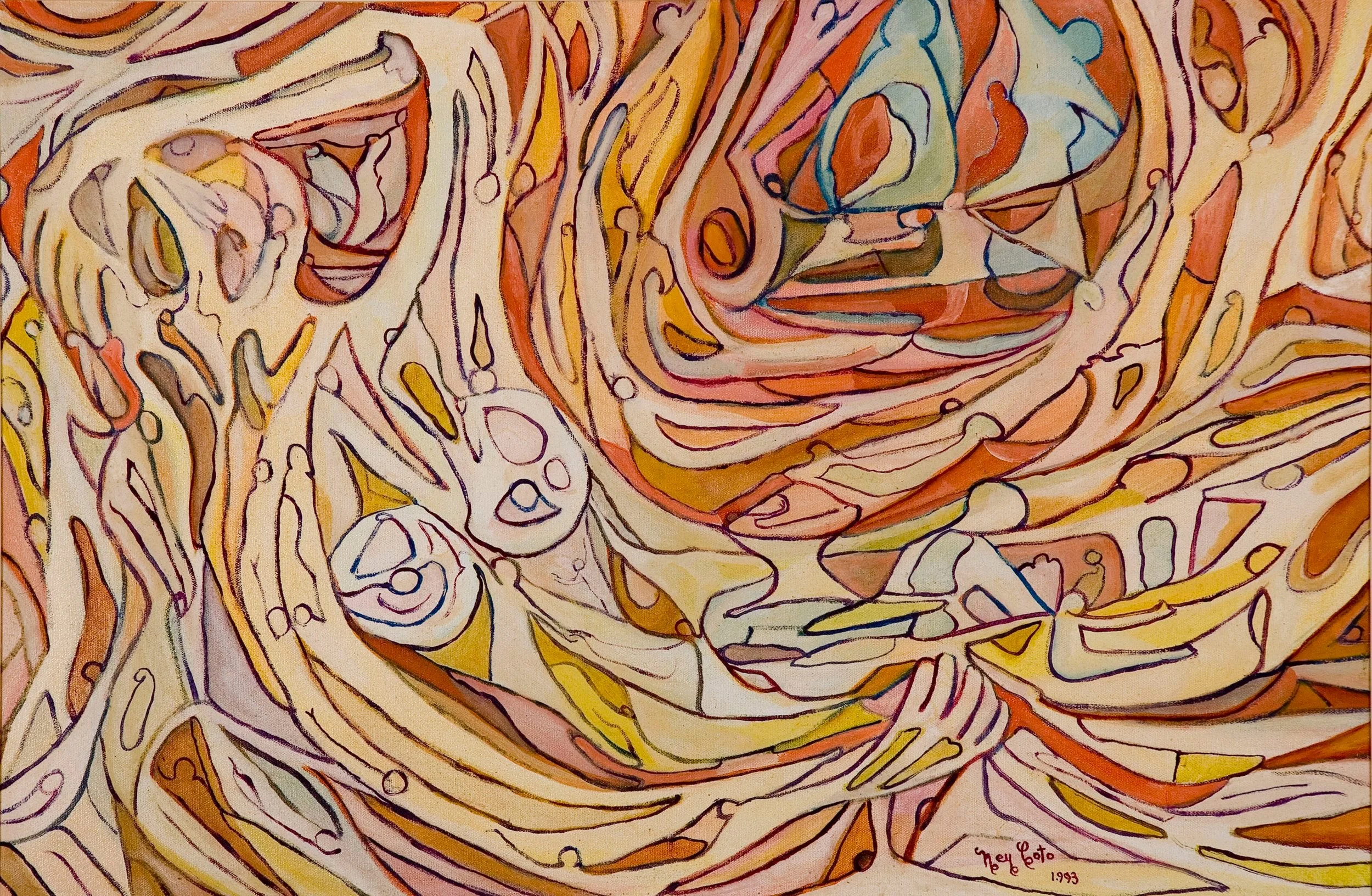
Capricho Lineal (1993) is a meditation on movement held within structure, where line becomes both impulse and discipline. The work seems to unfold from a space of controlled invention, in which rhythm, contour, and spatial tension are carefully balanced against one another. Rather than describing a literal scene, the painting suggests a state of energetic refinement: a visual current that feels playful, intuitive, and deliberate all at once. The title itself hints at an elegant caprice — something spontaneous, but guided by an underlying intelligence.
The composition appears to organize its forms through a linear logic that gives the painting its distinctive pulse. Lines do not merely delineate; they animate. They create pathways of attention, carrying the eye through a field where gesture and structure remain in constant conversation. What emerges is a sense of motion held in suspension, as though the image were capturing the instant when impulse becomes form. The painting does not resist vitality; it channels it, shaping feeling into a disciplined visual language.
The surface, with its layered texture and nuanced transitions, reinforces this tension between freedom and order. Earth tones, deep blues, muted violets, and selective accents of brightness give the work a sober yet lively atmosphere. In Capricho Lineal, line becomes more than a formal device: it becomes an expression of thought in motion, a way of organizing sensation without losing its spontaneity. The result is a painting that feels intellectually poised and emotionally alive, where structure itself acquires a kind of grace.
Espanol
Capricho Lineal (1993) es una meditación sobre el movimiento contenido dentro de la estructura, donde la línea actúa al mismo tiempo como impulso y disciplina. La obra parece desplegarse desde un espacio de invención controlada, en el que el ritmo, el contorno y la tensión espacial se equilibran cuidadosamente entre sí. Más que describir una escena literal, la pintura sugiere un estado de refinamiento energético: una corriente visual que se siente juguetona, intuitiva y deliberada a la vez. El título mismo insinúa un capricho elegante — algo espontáneo, pero guiado por una inteligencia subyacente.
La composición parece organizar sus formas a través de una lógica lineal que le da a la obra su pulso distintivo. Las líneas no solo delimitan; también animan. Crean recorridos de atención, llevando la mirada por un campo donde gesto y estructura permanecen en constante diálogo. Lo que emerge es una sensación de movimiento suspendido, como si la imagen capturara el instante en que el impulso se vuelve forma. La pintura no rechaza la vitalidad; la canaliza, convirtiendo la emoción en un lenguaje visual disciplinado.
La superficie, con su textura en capas y sus transiciones sutiles, refuerza esta tensión entre libertad y orden. Los tonos tierra, los azules profundos, los violetas apagados y los acentos selectivos de luminosidad le otorgan a la obra una atmósfera sobria pero viva. En Capricho Lineal, la línea se convierte en algo más que un recurso formal: se vuelve una expresión del pensamiento en movimiento, una manera de organizar la sensación sin perder su espontaneidad. El resultado es una pintura intelectualmente equilibrada y emocionalmente viva, donde la estructura adquiere una cierta gracia.